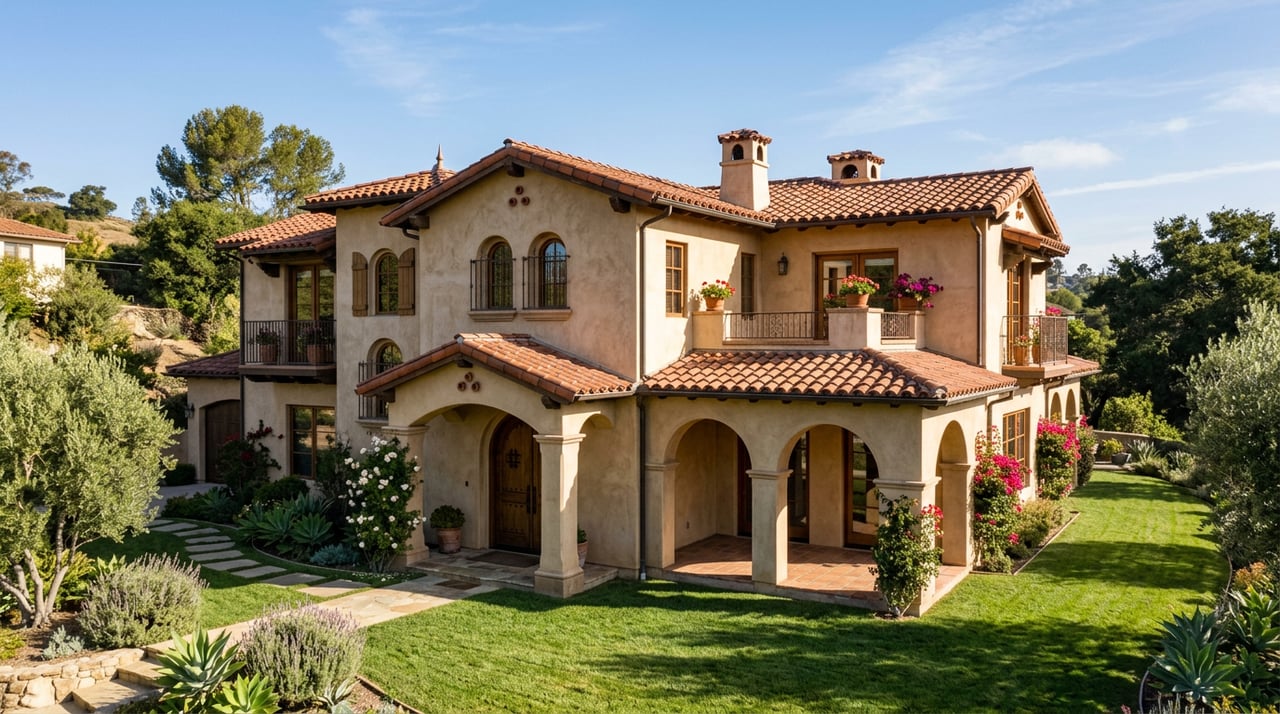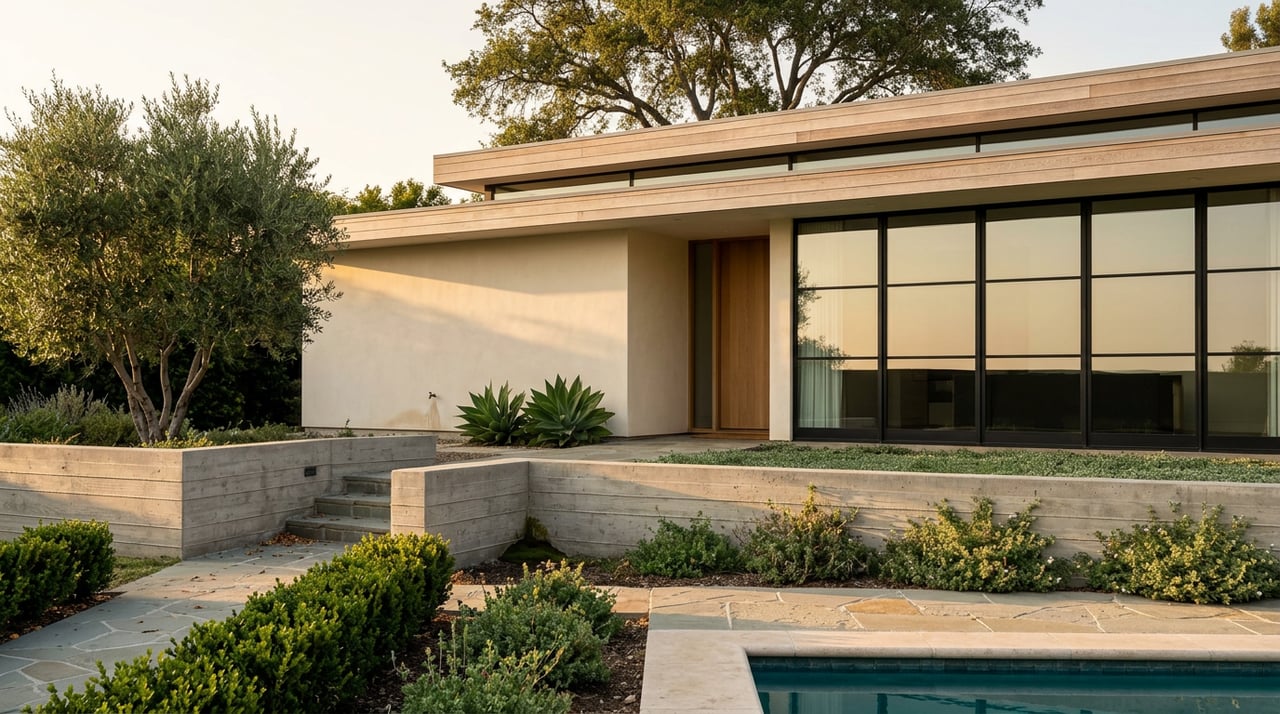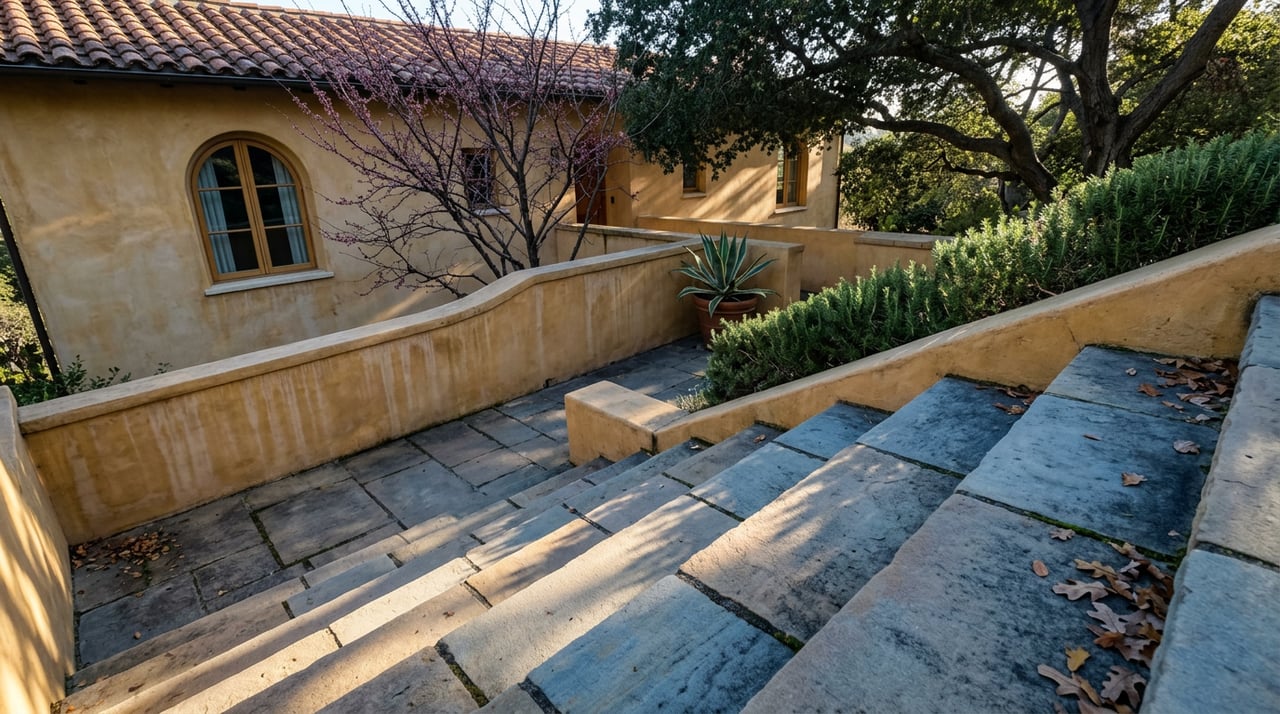
Every stair-walking guide to Los Angeles has its famous entries. The Music Box Steps in Beachwood Canyon, where Laurel and Hardy filmed their Oscar-winning short. The Sunset Junction loop through Silver Lake, dotted with murals and coffee stops. Both draw crowds on a Saturday morning, phones out, checking off a bucket-list item.
Mount Washington's loop draws almost nobody outside the neighborhood. Not because it's hidden. It's listed in the same guidebook as the famous walks, right there in the table of contents. It stays quiet because it's brutal, and that turns out to be the whole point.
The Street Grid Is a Fossil
Drive through Mount Washington and the streets stop making sense in the way a normal city grid makes sense. Canyon Vista Drive doubles back on itself. Mount Washington Drive curves along a ridge instead of cutting straight through it. There's a reason for that, and it predates every resident currently living there.
The neighborhood was subdivided in 1909 by developer Robert Marsh, who built a hotel at the summit and then solved the obvious problem, how do you get people up a hill this steep, by running a funicular railway from the bottom to the top. The Los Angeles and Mount Washington Railway operated until January 1919, when it was torn out and replaced by roads that had to follow the same impossible grade the train once climbed.
That history is why the neighborhood still feels like it wasn't built for cars. The roads exist because a railway used to be there first, not because a planner drew a grid and expected traffic to flow through it. Every hairpin turn you take on a walk here is a street engineer's compromise with terrain that was never going to cooperate.
What You're Actually Climbing
The walk itself starts at the base of Avenue 43, just uphill from Marmion Way, on the literal bed of that old funicular line. You climb a staircase of roughly 102 steps across several landings before the pavement takes over on Canyon Vista Drive, and the pavement doesn't let up. It's a steep half-mile climb from there, the kind that has you checking how much farther before you stop checking and just keep going.
At the top, the road bends onto San Rafael Avenue, where the wrought-iron gates of the Self-Realization Fellowship's international headquarters mark the high point of the loop. The property was founded by the monk Paramahansa Yogananda and functions as a working spiritual center, not a museum, with gardens, a chapel, and a meditation practice that's been running on that hillside for decades. You're welcome to walk through during open hours and take in the quiet before the descent starts.
From there the route drops through Moon Canyon Park, a small pocket of undeveloped land tucked into the hillside, before Museum Drive carries you back down to Marmion Way and the starting point. Loop closed.
Do the whole thing and you're looking at close to two hours on your feet, most of it either climbing or descending, none of it flat.
The Hardest of Forty-Two
Charles Fleming has spent more than a decade cataloging Los Angeles's public staircases in his book Secret Stairs, revised again earlier this year. The guide covers 42 circular walks across the entire city, from Pasadena to Santa Monica, each one rated for duration and difficulty.
Mount Washington's loop is listed as walk number five. It's also the longest walk in the entire book and carries one of the highest difficulty ratings Fleming assigns, a 4.5 out of 5. Out of everything the guide covers across the whole of Los Angeles, this is the one that takes the longest and asks the most of your legs.
That fact changes how you should read the neighborhood's quiet reputation. It isn't that Mount Washington kept its walk a secret through some accident of geography or marketing. The walk is published, mapped, and sitting in a bestselling guidebook right alongside the Music Box Steps. It stays uncrowded because most people who'd photograph a staircase for social media aren't signing up for a two-hour, 4.5-difficulty climb before breakfast. The walks that get overrun are the ones you can finish in forty minutes with a stroller. This one filters itself.
The Locked Gate at the Top
If you follow Fleming's original route to its endpoint, you land at the gates of the Southwest Museum, a hilltop Mission Revival building with a tower modeled on the Caracol at the Alhambra in Granada, Spain. It was completed in 1914 as the permanent home for a Native American art and artifact collection assembled by Charles Lummis, and for most of the twentieth century it was one of the city's genuine cultural landmarks.
It has been closed to the public since September 2022, when a fire inspection turned up structural and safety issues serious enough that its owner, the Autry Museum of the American West, shut the campus down entirely. That closure came after years of limited Saturday-only hours and more than a decade of the Autry searching, without success, for an organization willing to take over the site. Nothing has changed that status since. The building still stands. The tower is still visible from Figueroa Street and the 110 Freeway. Nobody has walked through its front doors in years.
Walking the loop today means ending at a gate that isn't going to open, and that's not a complaint about the neighborhood. It's part of what the walk actually shows you. If the full climb feels like too much on a given morning, Kite Hill on West Avenue 37 gives you a shorter version of the same payoff, an unobstructed view of downtown and the San Gabriels without the two-hour commitment.
What the Neighborhood Built Around the Climb
Everything else here runs on the same logic as the stairs. Eldred Street, between Avenue 50 and Cross Avenue, carries a 33 percent grade, making it one of the steepest streets in the country. Mount Washington Elementary, the neighborhood's only school, has built a reputation on the kind of parent involvement you only get when a community is small enough that everyone knows whose turn it is to run the garden program. Cleland Park hosts an annual neighborhood potluck, the sort of event that doesn't need advertising because word travels a few blocks in either direction.
One longtime resident summed the place up simply: "LA's best kept secret." That's not marketing copy. It's what happens when the terrain itself keeps a neighborhood a little harder to access, a little slower to discover, and a little more likely to stay exactly the way the people who live there want it to stay.
The loop is the clearest version of that story you can walk. It's steep because the land is steep. It's quiet because it's hard. And the landmark at the top has been waiting for someone to reopen it for so long that its closed gates have become part of the neighborhood's texture rather than a problem anyone expects solved by next spring.
That's Mount Washington in miniature. Not undiscovered. Just demanding enough that it stays exactly the size of the people willing to make the climb.
If you're already one of them, and you're weighing what's next for a house on this hill, whether it's the kind of renovation that respects a place built on a century-old railway grade, or simply understanding what your property is worth in a neighborhood this specific, Alyssa Valentine + Anselm Clinard know these streets from the inside. Contact us when you're ready to talk.