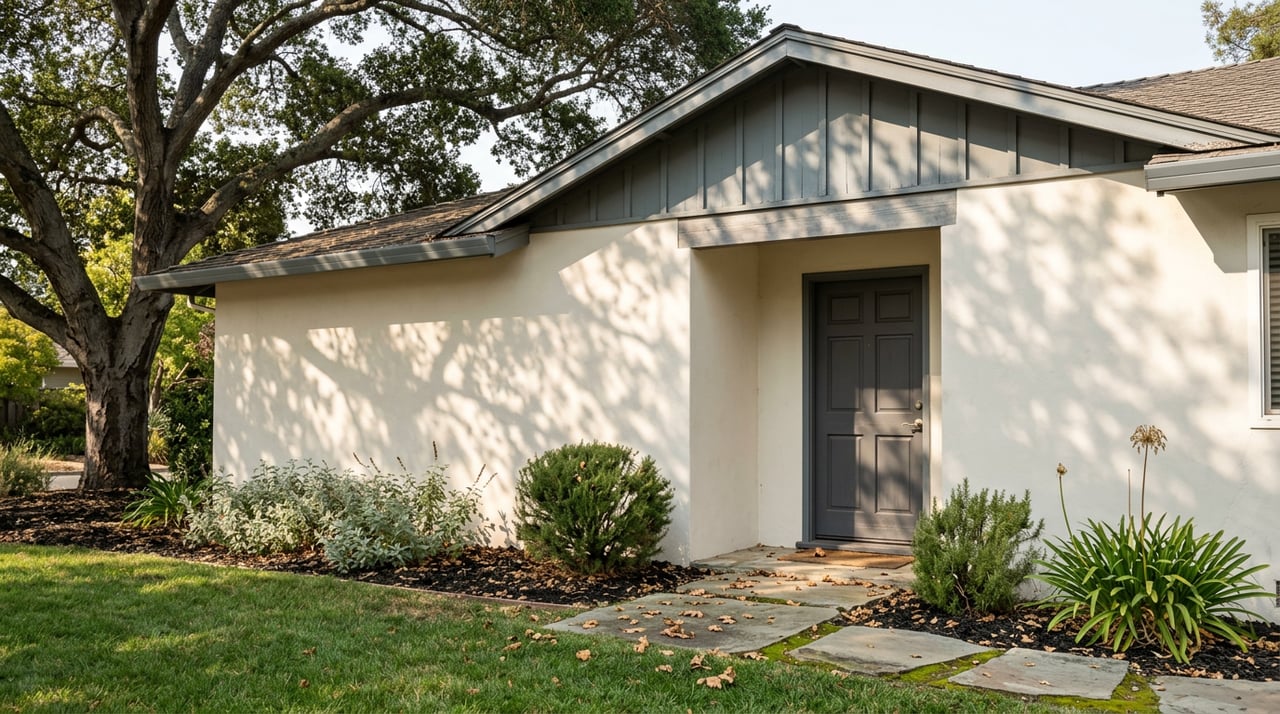
If your Altadena home came through the Eaton Fire standing, you are selling into a market that looks nothing like the one the portals are describing. The comp set is thin and skewed. Your buyer pool is smaller than the search traffic suggests. And the single largest variable pushing offers up or down is not your kitchen finish or your list price. It is the annual cost of insuring the house you are trying to sell.
That is the thesis of this post, and it drives every decision below. In post-Eaton Altadena, sellers who front-load insurability evidence and disclosure documentation expand their buyer pool. Sellers who lead with staging alone are quietly pricing into a shrunken pool without knowing it.
The comp confusion, and why it matters at the pricing meeting
Pull up three different data feeds today and you will get three different Altadena markets.
Redfin's read for the three months ending May 2026 puts the median sale price at roughly $1.3M, up 63.6% year over year, with homes selling in about 38 days on 7 offers on average. Zillow's ZHVI in the same window shows the typical Altadena home value at about $1.17M, down 3.8% year over year. The Real Deal's April 2026 review traced the arc more honestly: a pre-fire peak near $1.5M in September 2023, a collapse to $710,000 in March 2025 right after the fire, and a partial recovery to $990,000 by February 2026.
These numbers are not in conflict. They are measuring different things through a distorted sample. Redfin's percentage jump reflects a mix shift toward intact homes in the least fire-affected pockets. Zillow's ZHVI, built off automated valuations, is dragged down by lots and damaged parcels. The Real Deal is closest to the truth of what a standing, unaffected home is actually clearing at.
The practical read for a seller: your comp set is smaller than the raw sold count implies, because half of what closed in the last twelve months is a different asset class (bare lots, partial damage, insurance-driven sales). Filter aggressively. If a comp sold within the burn footprint or transferred to a rebuild firm, it is not your comp.
The number your buyer is running that you are not
Before a buyer writes an offer on an intact Altadena home, they are pricing insurance. That step, more than the interest rate, sets the ceiling on what they can pay.
Where the admitted market has stepped back, buyers are routinely quoted a California FAIR Plan policy plus a Difference in Conditions wrap. FAIR Plan is bare fire coverage: no liability, no theft, no water. The DIC fills the gaps. Combined annual premiums for Altadena homes in the $900,000 to $1.4 million range are running roughly $8,000 to $18,000 a year, which is three to five times what a comparable homeowner paid before 2023.
Here is what that does to buyer math on a $1.2M purchase with 20% down:
| Insurance scenario | Annual premium | Monthly impact | Rough purchasing-power shift |
|---|---|---|---|
| Pre-2023 admitted market | ~$3,000 | $250 | Baseline |
| FAIR Plan + DIC, low end | $8,000 | $667 | ~$70k less house |
| FAIR Plan + DIC, high end | $18,000 | $1,500 | ~$160k less house |
A buyer who assumed a standard HO-3 policy in their pre-approval discovers the real number during the appraisal contingency. That is when they renegotiate. Or walk.
The move: get an insurance pre-quote in the seller's name before you list. If your home already qualifies for admitted-market coverage, or if you have documentation that materially lowers a FAIR Plan quote, that letter belongs in the disclosure packet on day one. It is worth more than a staging refresh at this price point.
Disclosure work that belongs on the pre-listing calendar
California disclosure requirements have layered up since the fire, and the ones that used to be handled in escrow are now signal to a nervous buyer. Handle them before you sign a listing agreement, not after.
- AB 38 home-hardening disclosure. If your home was built before January 1, 2010 and sits in a mapped High or Very High Fire Hazard Severity Zone, you owe the buyer a home-hardening notice covering roof, eaves, vents, decks, windows, and defensible space. Since July 1, 2025, that notice must also include the State Fire Marshal's list of low-cost retrofits. The statute is here. Post-Eaton hazard maps expanded, so parcels that were exempt in 2024 may not be in 2026.
- Natural Hazard Disclosure Statement under Civil Code §1103. Standard on every residential sale. It flags FHSZ and other hazard zones. Order it early so the report is in the packet at first showing.
- Defensible-space inspection. Reports are valid for six months. A clean report attached to the disclosure packet answers a question your buyer's agent was going to ask anyway.
- Transfer Disclosure Statement. For any home in the burn corridor, this is where you disclose smoke exposure history, remediation work, outstanding insurance claims, and any repair activity since January 2025. Incomplete answers here are where post-close disputes start.
If the structure is fully intact and untouched by smoke, say so plainly and document it. Ambiguity is what buyers price down.
The block-by-block signal buyers are actually reading
Buyers driving Altadena in 2026 are not reading MLS remarks. They are reading the street.
A block with active rebuild permits, a tidy Williams Rebuild sign, and Southern California Edison crews finishing undergrounding reads as recovery in motion. Williams Rebuild alone is working through roughly 30 Altadena residential projects, and SCE has committed to putting 63 miles of Altadena power lines underground. Those visible signals matter to a buyer weighing whether their $1.2M is buying into a neighborhood or a construction zone.
The Lake Avenue corridor is doing similar work above ground. Mariposa Junction at Lake and Mariposa reopened with Two Dragons, Ms. Dragon's Print and Copy, Fairoaks Burger, and neighboring tenants back in business. The Altadena Community Center reopened June 8, 2026 after fire damage and renovation, hosting the Altadena Chamber, Altadena Heritage, and the Altadena Historical Society among others. LA County's Altadena SmallBiz Permit Express and the Altadena Commercial Concierge Program announced June 25, 2026 are compressing rebuild timelines for the commercial parcels that surround residential blocks.
The seller's task is to make those signals legible in the marketing. If your block is west of Lake with no burn scars visible from the door, the photography should show that. If a favorite reopened business is a five-minute walk away, name it in the description. Generic "close to shops and dining" copy is invisible in 2026. Named businesses are the proof.
A pricing approach that respects the split market
Given the comp distortion and the insurance drag, the pricing methods that worked in 2023 will misfire now.
A workable frame:
- Anchor to intact-home comps only. Strip out any sale within the burn footprint, any lot transfer, and any sale to a rebuild entity. What remains is usually a much smaller set than the raw sold count. Adjust for that thinness by widening your window to twelve months rather than three.
- Build the buyer's carrying-cost model first. Estimate their all-in monthly cost including a realistic insurance premium. Back into a list price that survives that model, not one that ignores it.
- Price to generate multiple offers, not to test the ceiling. With three months of supply nominally, but a fragmented buyer pool actually, the risk of a price reduction reads much worse in this market than in a normal one. A reduction now signals "there is something wrong with this house" in a market where buyers are already scanning for wildfire concerns.
- Bring the insurance letter to the first offer conversation. It shortens the appraisal-contingency renegotiation window and, in the best cases, eliminates it.
Sellers who do this consistently see the sale-to-list ratio behave the way it did pre-fire. Sellers who do not are watching offers come in soft and blaming the market.
FAQ
Does AB 38 apply if my home was fully spared and shows no fire damage? It applies based on when the home was built and whether it sits in a mapped High or Very High Fire Hazard Severity Zone, not on whether it burned. Post-Eaton map updates expanded coverage, so re-check the current NHD even if you sold a neighboring property in 2023.
Should I get a public adjuster involved before listing if I have an open smoke claim? Only if the incremental settlement will exceed the fee and the delay. Public adjusters typically charge 10% to 15% of the claim payout. If your claim is close to a fair settlement and speed matters more than the last dollar, the delay usually costs more than the fee returns. This is a case-by-case call, not a rule.
Are institutional buyers a factor for intact homes, or just for lots? Mostly for lots. Early post-fire data from one Altadena broker showed roughly 56% of lot sales going to corporate or institutional buyers at a median around $515,000. Intact-home sales are still an owner-user market, which means marketing, staging, and disclosure hygiene matter the way they always have.
How long is the current window before conditions shift again? Three variables move this market: FAIR Plan availability, rebuild pace on your block, and admitted-carrier re-entry. Any of them can shift the pricing frame within a quarter. Plan the listing on a six-week horizon, not a six-month one.
If you are weighing a 2026 sale on an intact Altadena home, the preparation window matters more than the calendar date. Alyssa Valentine + Anselm Clinard work with foothill sellers on the disclosure packet, the insurance letter, and the pricing model before the sign goes in the yard, so the offer conversation starts from strength. Reach out when you are ready to talk specifics.